
By Dr. Anirudh Reddy | MBBS, MD Dermatology | Fellowship in Hair Transplantation and Aesthetic Medicine | Member – FUE Asia
Last reviewed: September 2026 | 12+ years experience | 1500+ successful Hair Transplant Surgeries
Every week, patients come to my clinic having already decided which technique they want. Some have read that DHI is the more advanced option. Others have been told FUE is safer. A few have been quoted both and are confused about why the prices are so different for what sounds like the same result.
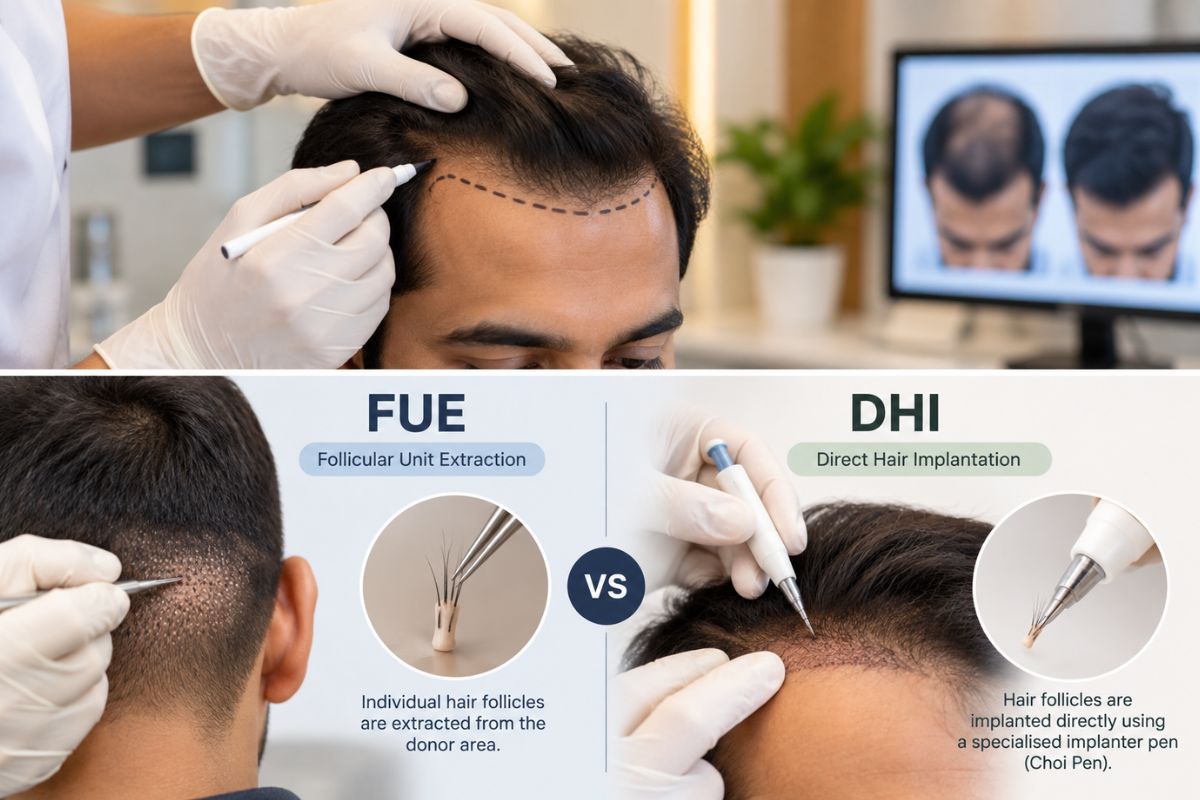
Here is the honest answer: FUE vs DHI hair transplant is not a choice between two competing technologies. DHI is a modification of FUE. The extraction method is identical in both. What changes is how the grafts are implanted. That one difference does matter, but it matters in specific ways depending on your scalp, your hair loss pattern, and what you are trying to achieve.
I perform both. Here is how I actually decide between them.
What FUE and DHI actually mean
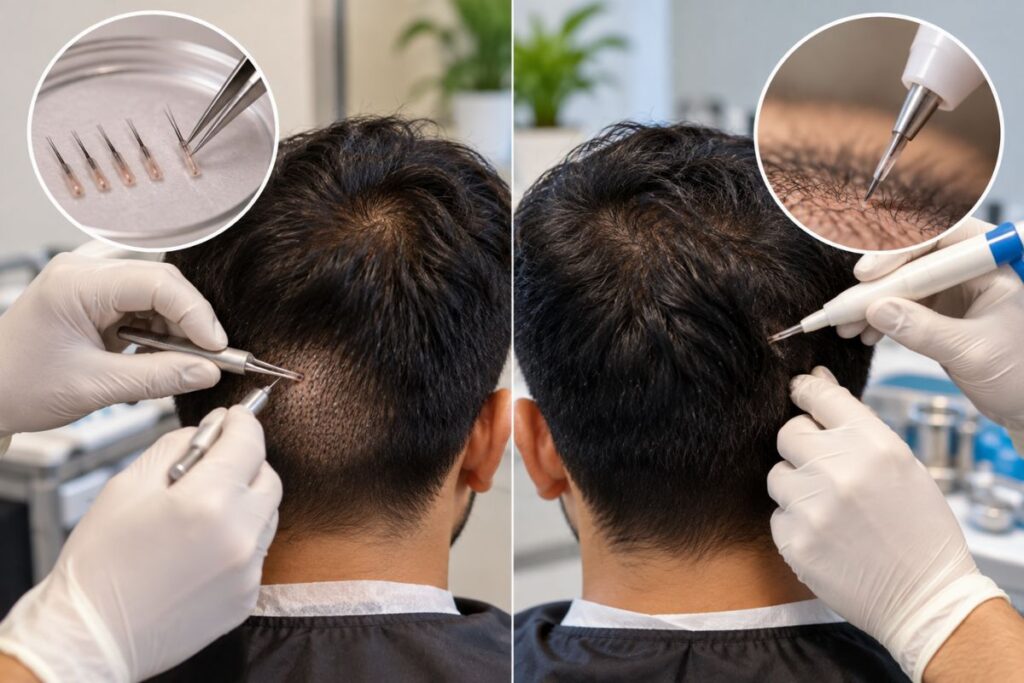
FUE stands for Follicular Unit Extraction. Individual hair follicles are extracted one by one from the donor area at the back of the scalp using a micro-punch tool. The surgeon then creates small channels in the recipient area and places the extracted grafts into those channels.
DHI stands for Direct Hair Implantation. The extraction from the donor area is the same as FUE. The difference is in the implantation step: instead of creating channels first and placing grafts second, a DHI surgeon uses a pen-shaped device called a Choi implanter that combines both steps into one motion. The pen creates the channel and deposits the graft simultaneously.
That is the entire technical distinction. The Choi pen is not magic. It does not make DHI superior in every case. But it does change what is surgically possible in specific situations, which is why both techniques have a place.
FUE vs DHI: the comparison at a glance
The table below summarises the clinical differences. Read through it and then read the sections after it, because the table alone will not tell you which one is right for your scalp.
| FUE | DHI | |
|---|---|---|
| How grafts are placed | Channels created first, grafts placed after | Choi pen creates channel and places graft simultaneously |
| Best for | Large areas, high graft counts, full coverage | Hairline precision, adding density into existing hair |
| Shaving required | Donor area shaved; recipient area usually shaved | Donor area shaved; recipient area can remain unshaved |
| Graft survival | Very high with an experienced surgeon | Slightly higher in some studies due to reduced out-of-body time |
| Session length | Typically shorter for same graft count | Longer — one graft placed at a time with the pen |
| Cost per graft | Lower | Higher — pen technique requires more surgical time |
| Scarring | Tiny dot scars in donor area, invisible at normal length | Same as FUE — identical extraction method |
| Recovery | 7 to 10 days surface healing | Slightly faster due to smaller recipient incisions |
| Who it suits | Norwood 4 and above, larger bald areas | Norwood 2 to 4, hairline-only cases, women |
The most important line in that table is the last one. The technique should be chosen for the patient, not the other way around.
When I recommend FUE
Large areas of hair loss
FUE is more practical when the bald area is significant, typically Norwood Stage 4 and above. Because grafts are placed after channels are created, the surgeon can work faster across a large area. A session that requires 3,000 or more grafts is almost always done as FUE at my clinic. Doing the same graft count with a DHI pen takes considerably longer and exhausts the surgical team.
Patients who need maximum graft count in one session
The Choi pen works one graft at a time and requires more handling per graft. When a patient needs 3,500 to 4,500 grafts in a single session, FUE gives us the efficiency to deliver that safely without compromising graft quality through prolonged out-of-body time.
Budget-conscious patients who want the same quality result
FUE costs less per graft because the implantation step is faster. For most patients with medium to advanced hair loss, FUE produces results that are indistinguishable from DHI at a lower total cost. Paying more for DHI when FUE would produce the same result for your specific case is not something I encourage.
When I recommend DHI
Hairline design requiring surgical precision
The Choi pen gives the surgeon precise control over the angle, direction, and depth of each graft as it is placed. For hairline work, where each follicle needs to mimic the natural growth direction of hair at the frontal zone, DHI gives a level of control that manual channel-and-place FUE cannot always match. If your primary goal is a natural, undetectable hairline rather than coverage of a large bald area, DHI is often the better choice.
Adding density into existing hair
When a patient still has hair in the recipient area but wants to increase density, DHI is significantly better. Creating channels in an area with existing hair risks damaging those follicles. The DHI pen can be placed between existing hairs with more precision, minimising trauma to the surrounding area. This makes DHI the standard choice for density work and for patients who are not fully bald in the zone being treated.
Patients who cannot shave the recipient area
FUE typically requires the recipient area to be shaved so the surgeon can see clearly when creating channels. DHI can be performed without shaving the recipient area because the pen does not require a pre-cleared field. For professionals, women, or anyone who needs to return to public life quickly without visible signs of surgery, DHI offers more discretion.
Women with hair loss
Female hair loss tends to present differently from male pattern baldness. Women often have diffuse thinning across the scalp rather than clearly bald patches, and they are understandably reluctant to shave their heads. DHI is almost always my recommendation for female patients because it allows treatment of thinning areas without shaving, and because the precision of the pen suits the kind of density work female cases typically require. For a full picture of what hair transplant options exist for women, the female hair transplant page on this site covers the specific considerations.
The question I hear most: is DHI better than FUE?
No. And yes. It depends entirely on what your scalp needs.
DHI is not a newer or more advanced version of FUE. It is a different tool for a different set of clinical situations. A DHI procedure done on the wrong patient, or by a surgeon without experience with the Choi pen, will produce a worse result than a well-executed FUE. Conversely, doing FUE on a patient who needs hairline precision work will produce a result that looks slightly less natural than DHI would have.
The question is not which technique is better. It is which technique is better for you. That requires looking at your scalp, your Norwood stage, your donor density, and your goals before any answer can be given.
If a clinic recommends a technique before examining you, they are recommending their default, not your best option.
What about cost?
DHI typically costs more per graft than FUE because the implantation step takes longer and requires more surgical precision. At my clinic, the difference reflects the actual additional time and skill involved, not a marketing premium.
For patients with large bald areas who are candidates for FUE, I do not recommend DHI on the basis of cost alone. The result will be the same or better with FUE, and you will save on the total cost. For patients who genuinely need DHI, the additional cost is justified by the clinical outcome.
For a complete breakdown of what hair transplant procedures cost in Hyderabad across different graft counts and techniques, the hair transplant cost guide on this site covers it in full.
What actually determines your result
The technique matters. The surgeon matters more.
A DHI procedure done by an inexperienced surgeon with a Choi pen will produce a worse result than FUE done by a surgeon with strong technical judgment and 1,500 procedures behind them. The tool is only as good as the person using it.
What I look at before recommending either technique: your Norwood stage and the total area needing coverage, the density and quality of your donor zone, whether you have existing hair in the recipient area, your hairline goals and how natural the result needs to look, and your timeline for returning to normal activity.
All of that goes into the recommendation. The technique question is usually one of the easier decisions by the time we have assessed everything else. Understanding how graft count works alongside technique selection is covered in the how many grafts do I need guide on this site.
Not Sure Which Technique Is Right for You?
FUE or DHI is a decision I make after examining your scalp, not before. Book a consultation with Dr. Anirudh and get a clear recommendation based on your hair loss stage, donor density, and what you actually want to achieve.
Explore:
Hair Transplant at Dr. Anirudh’s Clinic |
Hair Transplant Cost in Hyderabad |
Questions to Ask Your Surgeon




0 Comments