

By Dr. Anirudh Reddy | MBBS, MD Dermatology | Fellowship in Hair Transplantation and Aesthetic Medicine | Member – FUE Asia
Last reviewed: August 2026 | 12+ years experience | 1500+ successful Hair Transplant Surgeries
It is one of the first things patients ask me. Sometimes they have already done the maths themselves online, arrived with a number in their head, and want to know if it is right. Sometimes they have no idea and find the question overwhelming. Both are fine starting points, because the honest answer is the same either way: the number of grafts you need for a hair transplant cannot be confirmed without examining your scalp. What I can do here is explain how the number is actually arrived at, what factors move it up or down, and why a graft count that sounds impressive is not always a good thing.
The baldness calculator on this site is a useful starting point for understanding your hair loss stage. What follows is the clinical reasoning behind the numbers.
What exactly is a graft?
A graft is a single follicular unit: a naturally occurring group of one to four hair follicles that grow together from one root. When we talk about 2,000 grafts, we are not talking about 2,000 individual hairs. A 2,000-graft procedure typically delivers somewhere between 4,000 and 5,000 individual hairs, depending on how many hairs each graft contains.
This distinction matters when clinics advertise graft counts, because some clinics count single hairs as grafts to make the number look larger. Always ask whether the quoted number refers to follicular units or individual hairs. At my clinic, we count follicular units, which is the international standard.
The Norwood scale and what it means for your graft count
The Norwood scale is the standard framework surgeons use to classify male pattern hair loss. It runs from Stage 1 (no loss) to Stage 7 (only a horseshoe of hair remaining at the back and sides). Your stage gives us the first and most important variable in graft planning.
The table below gives the typical graft ranges for each Norwood stage. These are starting points, not prescriptions. Your actual number will be refined based on your specific scalp.
| Norwood Stage | Hair Loss Pattern | Grafts Needed | Area Covered |
|---|---|---|---|
| Stage 2 | Slight temples recession | 1200 – 1500 | Hairline only |
| Stage 3 | Noticeable recession / early crown | 1,500 – 2,500 | Hairline + early crown |
| Stage 4 | Significant frontal loss + crown thinning | 2,500 – 3,500 | Frontal + crown |
| Stage 5 | Large bald area, narrow bridge remaining | 3,500 – 4,500 | Frontal + crown + mid-scalp |
| Stage 6 | Frontal and crown zones merge | 4,500 – 6,000 | Full coverage required |
| Stage 7 | Only horseshoe of hair remains | 6,000 – 8,000+ | Full reconstruction (multiple sessions) |
A few things worth noting from this table. First, Stage 7 often requires more than one session because the maximum number of grafts that can be safely extracted in a single procedure is typically 3,500 to 4,500. Beyond that, the donor area needs time to recover. Second, the ranges are wide because scalp size, hair characteristics, and desired density all vary significantly between patients at the same Norwood stage.
The factors that determine your actual number
Norwood stage tells us roughly how many cm² of scalp needs coverage. But the graft count is also shaped by several other factors that no online calculator captures.
Donor density
The back and sides of your scalp are the donor area, the region where grafts are harvested. The density of hair follicles in this zone determines how many grafts can be safely extracted without leaving the donor area looking thin. A patient with high donor density has more grafts available. A patient with naturally sparse donor hair has a more limited supply, which constrains what is surgically possible regardless of the size of the bald area.
Hair characteristics
Coarser, curlier hair creates more visual coverage per graft than fine, straight hair. A patient with thick, wavy hair may achieve a full-looking result with fewer grafts than someone with fine straight hair. This is one reason two patients at the same Norwood stage can receive very different graft count recommendations and both be correct for their individual case.
The area you want to prioritise
Not every patient wants or needs full scalp coverage in a single session. Many patients choose to address one zone, the hairline, the frontal third, or the crown, while leaving other areas for a future session. This is often the smarter approach for younger patients whose hair loss is still progressing. Transplanting strategically now preserves donor supply for later.
Your age and likely future hair loss
A 28-year-old at Norwood Stage 4 requires a very different surgical plan than a 48-year-old at the same stage. The younger patient’s hair loss may not have stabilised, which means transplanting aggressively now could leave visible asymmetry as natural hair loss continues around the transplanted area. Planning for the hair loss you are likely to have at 50, not just the hair loss you have today, is part of responsible graft planning.
Desired density
Some patients want to restore their hairline to look full and natural. Others are happy with a result that is clearly an improvement but not maximum density. The target density, measured in follicular units per cm², directly affects the graft count. Surgeons typically aim for 35 to 50 grafts per cm² in the transplanted area, compared to natural scalp density of 80 to 100 follicular units per cm². Strategic placement and hair characteristics make up the visual difference.
Why more grafts is not always better
This is the point most clinics skip when they are trying to sell a large package.
Your donor supply is finite. Every graft extracted is one that cannot be used again in a future session. Over-harvesting the donor area to deliver a large graft count today can leave you with a visibly thinned donor area and limited options for future procedures. A 28-year-old who gets 4,000 grafts in one session may find at 40 that there is little left to work with as further natural hair loss occurs.
A surgeon whose goal is your long-term result will be conservative with the donor area. They will plan for the hair you are likely to lose over the next two decades, not just the hair you have lost so far. This is why I sometimes recommend a lower graft count than a patient expects, or a staged approach across two sessions rather than one large session.
The right number of grafts is the number that gives you the best result today while leaving enough in reserve for tomorrow.
How graft count connects to cost
Hair transplant pricing in Hyderabad is typically calculated per graft. The total cost of your procedure is directly tied to the graft count. This is why getting an accurate graft count at consultation matters: it allows you to understand the real cost, not an estimate that gets revised upward once you have committed.
It is also why unusually low per-graft prices sometimes correlate with inflated graft counts. A clinic that quotes you 4,000 grafts when 2,500 would produce the same result is charging you more in total, even if the per-graft rate appears competitive. For a transparent breakdown of hair transplant costs in Hyderabad, the hair transplant cost guide on this site covers it in detail.
What happens at the consultation
When you come in for a consultation, here is the actual process for arriving at a graft count.
I examine your scalp using trichoscopy, which allows us to measure donor density precisely rather than estimating it by eye. We assess the area of hair loss and map the zones you want to address. We discuss your goals and your timeline. And we talk about your likely future hair loss pattern based on your age, family history, and current progression.
All of that goes into the graft count. The number we arrive at together is specific to your scalp, not taken from a chart.
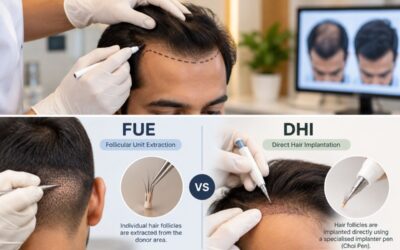
If you had a FUE procedure at another clinic and are considering a second session, we also assess how much donor supply remains and whether a further procedure is advisable. For a full picture of what the FUE and DHI procedure involves, the treatment page covers the technique in detail.
Want to Know Your Exact Graft Count?
No calculator can replace a proper scalp assessment. Book a consultation with Dr. Anirudh Reddy and get a graft count based on your actual donor density, your hair loss stage, and your goals.. not a generic estimate.
Explore:
FUE and DHI Hair Transplant |
Baldness Calculator |
Hair Transplant Cost in Hyderabad



0 Comments