
By Dr. Anirudh Reddy | MBBS, MD Dermatology | Fellowship in Hair Transplantation and Aesthetic Medicine | Member, FUE Asia
Last reviewed: June 2026 | 12+ years experience | 1,000+ procedures
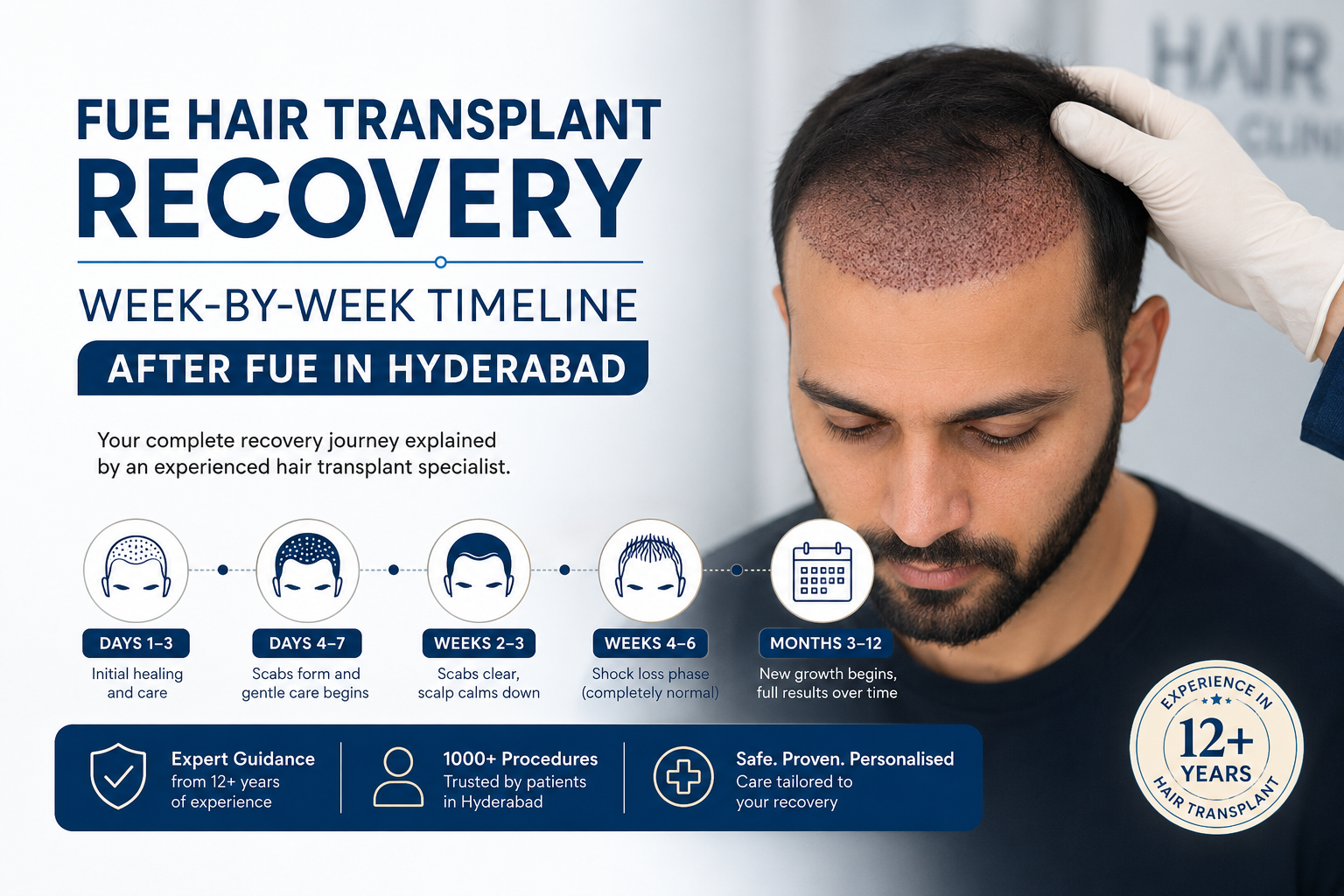
FUE hair transplant recovery takes 7 to 10 days for the scalp to heal on the surface, 1 to 2 weeks for the grafts to anchor properly, and 9 to 12 months to see your full result. Here is what every stage looks like and feels like, from someone who has watched over a thousand patients go through it.
Before We Start: The One Thing Most Patients Get Wrong
Patients who struggle during recovery are almost always the ones who were not prepared for what it would look like. They expected a straight line from surgery to results. The actual path has a twist in the middle that catches almost everyone off guard if nobody warns them.
So before the week-by-week breakdown: FUE recovery is not painful. It is slightly uncomfortable, and it has one phase that looks alarming but is completely normal. Knowing what is coming makes all the difference.
Days 1 to 3: Right After the Procedure
When you leave the clinic, your scalp will have tiny red dots at the donor area where the follicles were extracted, and small crusts starting to form at the recipient area where they were placed. This is exactly how it should look.
What you will notice in the first 3 days
- Mild swelling on the scalp. By day 2, some patients see this move to the forehead. It goes away on its own.
- Soreness at the donor area. Not sharp pain. More like the feeling after a mild sunburn.
- The grafted area looks red and slightly raised.
What I tell every patient before they go home
Sleep with your head raised at a 45-degree angle for the first three nights. In Hyderabad’s heat, it is tempting to sleep flat or to roll over during the night. Any pressure on the grafted area in the first 72 hours can dislodge grafts. Use a travel neck pillow if you have one.
Take your prescribed medications exactly as directed. No home remedies, no hair oils. Nothing touches your scalp unless I have specifically said it can.
Also worth knowing: FUE and DHI are both minimally invasive, but the aftercare rules apply equally to both. If you had DHI, the same first 72 hours apply.
Days 4 to 7: The Scabs Form and the Urge to Touch Them
By day 4, small scabs will have formed over each graft site. This is part of normal healing. They look concerning. They feel a little itchy. Do not pick at them.
Around day 5 or 6, I ask patients to start gentle washing using the technique I demonstrate at the clinic. Room (or) Normal temperature water poured very slowly over the scalp, a mild prescribed shampoo applied with your fingertips using a light patting motion. No rubbing. No scratching at all.
Specific advice for patients in Hyderabad
Hyderabad’s summer heat and the humidity during monsoon season cause more sweating than patients in cooler cities experience. If you are sweating heavily, keep the scalp as clean and dry as possible. Avoid direct sun without a loose-fitting cap. UV exposure on a fresh scalp causes unnecessary inflammation and can slow healing.
By the end of week 1, most of my desk-job patients are back at work. If your job involves physical effort or being outdoors, that is a different conversation we have at your follow-up.
Weeks 2 and 3: The Scabs Clear, the Scalp Calms Down
This is the week most patients start breathing easier. The scabs fall off naturally during washing, the scalp looks cleaner, and the redness starts to fade. It does not disappear fully yet, but there is clear progress.
What I clear patients for at the 2-week mark
- Light walking and gentle movement
- Return to most office and indoor environments
- Normal gentle hair washing without the special patting technique
What you still cannot do
Swimming, heavy gym sessions, contact sports, or anything that causes significant sweating or physical impact to the scalp. The grafts are healing well internally but they are not fully anchored yet. I have had patients push this and end up with patchy areas in the result. That is not something that is easy to fix later.
If you have been thinking about other options for areas that are thinning but not yet transplanted, this is a good time to read about non-surgical hair loss treatments that can slow or manage ongoing shedding while you recover.
Weeks 4 to 6: Shock Loss (The Phase Nobody Warns You About)
This is the phase that sends panicked messages to my phone.
Between weeks 3 and 6, the transplanted hair falls out. I want you to read that again: the transplanted hair falls out. This is called shock loss, and it is completely normal. The hair follicle goes into a resting phase called telogen after the trauma of being moved. The follicle itself is alive and healthy. It has just temporarily shed the hair shaft.
Patients who were not warned about this call me convinced the procedure failed. Looking in the mirror and seeing the grafted area look thinner than before surgery is genuinely alarming. But shock loss is one of the most predictable parts of the entire process.
My advice during this phase: stay off Instagram. Looking at someone else’s 6-month results when you are at week 5 and shedding is not good for your peace of mind.
How GFC therapy can help during this window
This is the phase where I often recommend GFC (Growth Factor Concentrate) therapy as an add-on. GFC uses concentrated growth factors from your own blood to support follicle recovery and early re-entry into the growth phase. Patients who do GFC sessions during months 2 to 4 tend to see earlier and denser growth in my experience. It is not a requirement, but it is worth discussing at your follow-up.
Months 2 and 3: Growth is Happening Under the Surface
Not much is visible on the surface during this window, but the follicles are actively regenerating below the scalp. Some patients see fine hairs coming through that look almost like peach fuzz. Others see nothing yet. Both are normal.
The absence of visible growth during months 2 and 3 does not mean nothing is happening. The follicle is going through anagen re-entry, which is the technical term for the growth phase restarting. This process takes time and varies from patient to patient. Patients with good scalp circulation and those who followed aftercare instructions carefully tend to see growth appear a little earlier.
I usually schedule a check-in around the 3-month mark to assess how healing is going and answer questions that have built up. This is also when we talk about whether GFC sessions or any supporting treatments make sense for your specific progress.
Months 4 to 6: You Will Start to See the Change
Month 4 is when things get exciting. New hair starts appearing visibly, though unevenly at first. The new hairs may look finer and slightly wavier than your natural hair. This normalises over time as the hair shaft matures.
By month 6, most patients have roughly 50 to 60 percent of their final result. Physical restrictions fully lift by month 3, so the gym, swimming, and all activities are back on. Just be sensible about sun protection if you are spending long hours outdoors in Hyderabad’s heat. If you are noticing thinning in areas not covered by the transplant, it is worth reading about what causes ongoing hair loss and whether any medical management makes sense alongside your result.
Months 9 to 12: Full Results
By month 9, the transplanted hair has thickened considerably and is blending well with your existing hair. By month 12, you have your full result. This is what stays with you permanently. The transplanted follicles come from the DHT-resistant donor area at the back of the scalp and will not follow the pattern of genetic hair loss.
At the clinic, I do a formal 12-month review with before-and-after photographs. It is one of my favourite appointments of the year. Most patients walk in not quite remembering what they looked like before surgery, and the comparison photos are usually a surprise even to them.
When to Call the Clinic Without Waiting
Most of what patients worry about during recovery is completely normal. But the following four things are worth a call or a message to the clinic right away:
- Pain beyond day 3 that your prescribed medication is not controlling
- Pus or discharge from any graft site
- High fever in the first week
- No growth at all by month 5 (rare, but worth checking)
If you are not sure whether something is normal or not, just message us. That is what the follow-up support is for.
Frequently Asked Questions
How long does FUE recovery take?
Most patients with desk jobs are comfortable going back to work within 3 to 5 days. The grafts are fully anchored by 2 to 3 weeks. Your complete result, meaning the full hair growth, takes 9 to 12 months.
When does hair start growing after FUE?
Visible growth usually begins around month 4. Fine new hairs appear first and gradually become thicker and more natural-looking through months 6 to 12.
Is shock loss after FUE normal?
Yes, completely. Most patients experience shedding of the transplanted hair between weeks 3 and 6. The follicle stays alive and grows back permanently. This is one of the most common things patients panic about, and one of the most predictable and harmless parts of the process.
What should I avoid in the first week after FUE?
Avoid direct sun exposure, heavy sweating, alcohol, smoking, sleeping flat, and touching or scratching the graft area. Start the gentle washing technique your clinic demonstrates from around day 5.
Can I drink alcohol or smoke after a hair transplant?
No, avoid both for at least 2 weeks after your procedure. Alcohol thins the blood and increases the risk of scalp swelling and bleeding. Smoking reduces blood flow to the scalp, which directly hurts graft survival and slows healing. I ask patients to stop smoking at least a week before the procedure as well. These are not optional guidelines.
When can I wear a helmet or cap after FUE?
A loose surgical cap provided at the clinic can be worn from day 1 for sun protection. A regular cap or helmet should be avoided for at least 3 weeks, as any pressure or friction on the recipient area can dislodge grafts before they are anchored. After the scabs clear fully, usually by week 2 to 3, a soft non-tight cap is generally fine.
Does FUE leave a scar?
FUE does not leave a linear scar. There are tiny dot-like marks at the extraction sites, but these become invisible once the donor area grows back to its normal length.
Is the result from FUE permanent?
Yes. The transplanted follicles are taken from the DHT-resistant zone at the back of the scalp. They retain that resistance after being moved, which means they will not fall out with pattern hair loss. The result is permanent.
Still Have Questions About Your Recovery?
Every patient’s scalp is different, and recovery timelines vary. If you are preparing for a procedure or already post-op and want to talk through what you are seeing, book a 15-minute discovery call with Dr. Anirudh’s team. No pressure, just an honest conversation.
Explore:
FUE and DHI Hair Transplant │
GFC Therapy │
All Hair Loss Treatments


Very well written Sir
Good Content and well explained