
By Dr. Anirudh Reddy | MBBS, MD Dermatology | Fellowship in Hair Transplantation and Aesthetic Medicine | Member – FUE Asia
Last reviewed: October 2026 | 12+ years experience | 1500+ successful Hair Transplant Surgeries
Almost every week, someone sits across from me and asks what my hair transplant success rate is. The question makes sense. It sounds like the right thing to ask before committing to a surgical procedure that will change how you look for the rest of your life.
My answer is always the same: what do you mean by success?
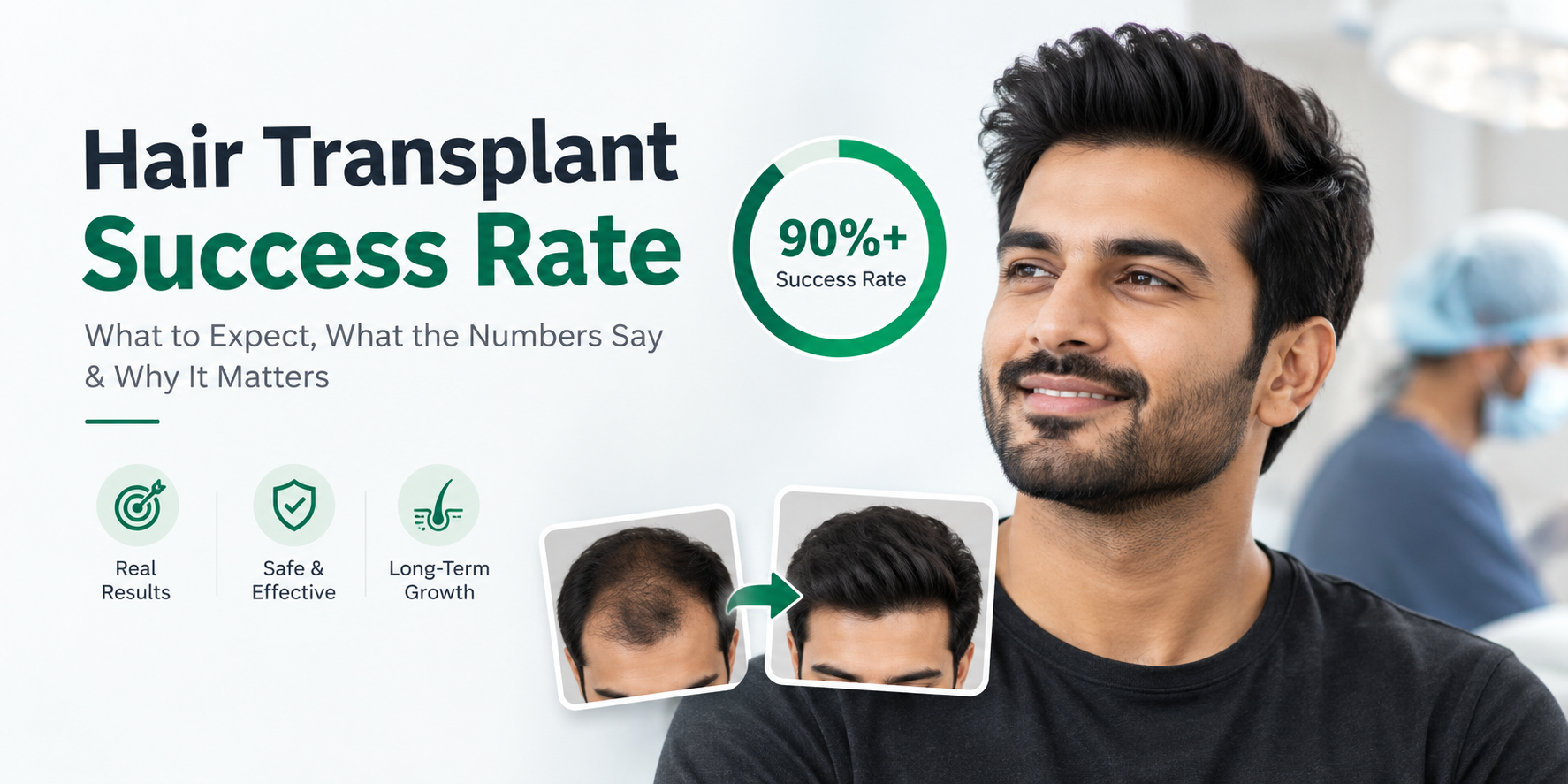
That is not a deflection. The number that clinics typically quote, somewhere between 90 and 95 percent, refers to one specific measurement: graft survival. How many of the extracted follicles survive the transplant process and continue to grow hair. That is a real and important number. But it does not tell you whether you will be happy with how your hair looks at the twelve-month mark. It does not tell you whether your hairline will look natural. It does not account for the surgeon’s aesthetic judgment, the quality of your donor zone, or whether the procedure was right for your hair loss stage in the first place.
Here is what success actually involves, and what determines whether you get the result you came for.
What graft survival rate actually measures
When a follicular unit is extracted from the donor area and implanted into the recipient area, it goes through a period of stress. The follicle is out of the body briefly, handled by instruments, placed into a new environment, and must re-establish a blood supply. Not every follicle survives that process.
Graft survival rate measures the percentage that do. In a well-run procedure by an experienced surgeon, this sits between 90 and 95 percent. Meaning if we transplant 2,000 grafts, you can expect between 1,800 and 1,900 of them to grow permanently.
Several things affect this number directly. How long grafts spend outside the body before implantation. The temperature and storage solution used during that window. The care and precision of extraction, which determines how much trauma each follicle sustains. How quickly the implantation step is completed. The time grafts spend outside the body stays shorter, and the process of reading each follicle’s condition and adjusting technique happens in real time.
A clinic that quotes 98 or 100 percent graft survival should be questioned, not celebrated. Surgical outcomes have natural variation. A number that leaves no room for it is either marketing or measurement that excludes the grafts that did not make it into the count.
Why a high graft survival rate does not guarantee a good result

This is where the gap between what clinics measure and what patients actually want becomes clear.
Imagine a procedure where 93 percent of grafts survive and grow. By the standard industry metric, that is a success. But if the hairline was designed without accounting for how it will age over the next decade, or if the grafts were placed at the wrong angle so the hair grows in an unnatural direction, or if the density was distributed evenly across a large area when it should have been concentrated at the front, then a patient looking in the mirror at month twelve may not feel that things went well.
The aesthetic outcome of a hair transplant is determined by surgical judgment, not just technical execution. Hairline design is the most visible part of this. Where to place the frontal line, how to create the slight irregularity that makes a hairline look grown rather than placed, how to factor in the patient’s age and likely future hair loss pattern. These are decisions that require experience and an eye for proportion. You can read more about how these decisions are made in the context of hairline reconstruction, but the principle applies to every hair transplant procedure regardless of technique.
Density distribution is the other major factor that does not show up in a graft survival figure. A surgeon with 500 procedures may place grafts evenly across the treatment area because it feels thorough. A surgeon with 1,500 will place them strategically, concentrating density where the eye reads first and where the visual impact is greatest. The total graft count can be identical. The result looks meaningfully different.
The three things that actually determine your outcome
Your donor zone
Everything starts here. The back and sides of the scalp contain follicles that are genetically resistant to the hormonal process that causes pattern hair loss. Those follicles retain that resistance after being moved, which is why transplanted hair is permanent. But the quality, density, and availability of your donor zone sets a ceiling on what any procedure can achieve. A patient with a dense, healthy donor area has more options than one whose donor zone is already thinned. No technique, no technology, and no surgeon changes that fundamental biology. An honest assessment of your donor zone before the procedure is not a formality. It is the most important part of the consultation.
How well matched the technique is to your case
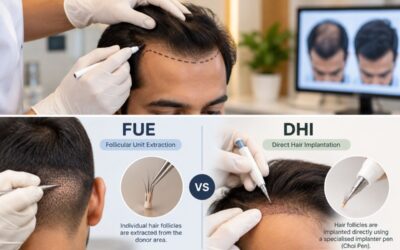
FUE and DHI are the two main implantation approaches in use at my clinic. The choice between them depends on what your scalp actually needs. For large areas of hair loss at Norwood Stage 4 and above, FUE is typically more efficient and better suited to delivering a high graft count in a single session. For hairline precision work, or for patients who still have existing hair in the treatment area and need density added between those follicles, DHI gives more control. A technique chosen because it is the clinic’s default rather than because it fits your case is one of the more common sources of avoidable suboptimal results. You can go deeper on this distinction in the FUE vs DHI comparison on this site.
Your aftercare
The procedure takes a day. The result takes twelve months. What happens during that window matters considerably. Grafts that are not fully anchored in the first two weeks are vulnerable to pressure, friction, and impact. Shock loss, which is the temporary shedding of transplanted hair between weeks three and six, is normal and expected, but patients who were not prepared for it sometimes panic and start trying home remedies that do more harm than the shed itself. Avoiding sun exposure, smoking, and alcohol in the early weeks is not optional guidance. These are factors with measurable effects on graft survival and healing speed. The hair transplant recovery guide on this site covers each stage in detail.
What failure actually looks like and what can be done
Genuine procedural failure is less common than patients fear, but it does happen. The most frequent causes I see when reviewing results from other clinics are aggressive over-harvesting of the donor area, hairlines designed without considering how hair loss will continue to progress, and grafts placed by untrained hands with inconsistent angles and depths.
A patchy result at the twelve-month mark can sometimes be addressed with a second procedure, provided the donor zone has not been depleted. A poorly designed hairline is more complicated to revise because the original grafts are permanent. This is why the first procedure being done correctly matters so much. Corrective work is harder, more expensive, and sometimes not fully possible.
If you are three to four months post-procedure and seeing uneven growth, it is worth knowing that the timeline for results is genuinely long. Month four is when growth typically begins to appear. Month six gives roughly half the final result. Month twelve is when you are seeing what you will actually live with. Panic at month four is almost always premature. If you are at month twelve and coverage is significantly uneven in a way that does not reflect the natural variation of hair growth, that is a conversation worth having with the surgeon who performed it.
How to evaluate a clinic’s actual track record
Before and after photographs are the most direct evidence available to you. The important questions when looking at them: are these cases comparable to yours in terms of hair loss stage and hair type? Do the results show twelve-month photographs, not six-month ones? Does the hairline look like it grew that way, or does it look placed? Is the donor area intact in the after photographs?
Clinics that show only their standout results, or that only photograph patients with a very different starting point to yours, are not giving you useful information. Ask specifically to see cases similar to your Norwood stage. A surgeon with a large enough case volume should be able to show you several.
The other signal worth paying attention to is how a clinic handles the consultation itself. A surgeon who rushes to confirm you as a candidate, quotes a graft count before examining your scalp, or answers questions about technique with marketing language rather than clinical reasoning is giving you information about how the procedure will be managed. These things do not improve once you have booked.
Frequently Asked Questions
What is a realistic hair transplant success rate?
Graft survival rates of 90 to 95 percent are realistic at experienced clinics. Claims of 100 percent survival should be questioned. Beyond graft survival, whether a patient is satisfied with their aesthetic result depends on hairline design, density distribution, and the match between technique and case, none of which are captured in a single percentage.
Can a hair transplant fail completely?
Complete failure, where no grafts survive, is extremely rare with modern FUE techniques. More common issues are partial regrowth due to poor donor zone quality, uneven density from suboptimal placement, or an aesthetic result that does not match expectations. These outcomes are more likely when the procedure is performed by untrained technicians rather than the consulting surgeon.
How do I know if my hair transplant is working?
Expect shock loss between weeks three and six. Fine new growth typically appears around month four. By month six you will have roughly half the final result. Month nine to twelve gives the complete picture. If you are seeing no growth at all by month five, that is worth raising with your surgeon.
Does the technique affect success rate?
Technique affects which cases it is suited to more than it affects raw graft survival numbers. FUE and DHI can both achieve similar graft survival rates in the right hands. What changes is the precision of placement, the suitability for different hair loss patterns, and how well the result looks in the long term. Surgeon experience and case-technique matching matter more than the technique name itself.
What affects graft survival the most?
The key factors are: how long grafts spend outside the body, storage conditions during that time, the precision of extraction, the speed of implantation, and your aftercare in the first two weeks. Smoking, alcohol, sun exposure, and physical pressure on the graft sites in the early recovery period all have measurable negative effects.
Want to Know What a Realistic Result Looks Like for Your Scalp?
The success rate that matters is the one on your scalp at month twelve. Book a consultation with Dr. Anirudh to get an honest assessment of your donor zone, your Norwood stage, and what a procedure designed for your specific case can realistically achieve.
Explore:
FUE and DHI Hair Transplant |
Hair Transplant Recovery |
Questions to Ask Your Surgeon



0 Comments