
By Dr. Anirudh Reddy | MBBS, MD Dermatology | Fellowship in Hair Transplantation and Aesthetic Medicine | Member, FUE Asia
Last reviewed: July 2026 | 12+ years experience | 1500+ successful Hair Transplant Surgeries
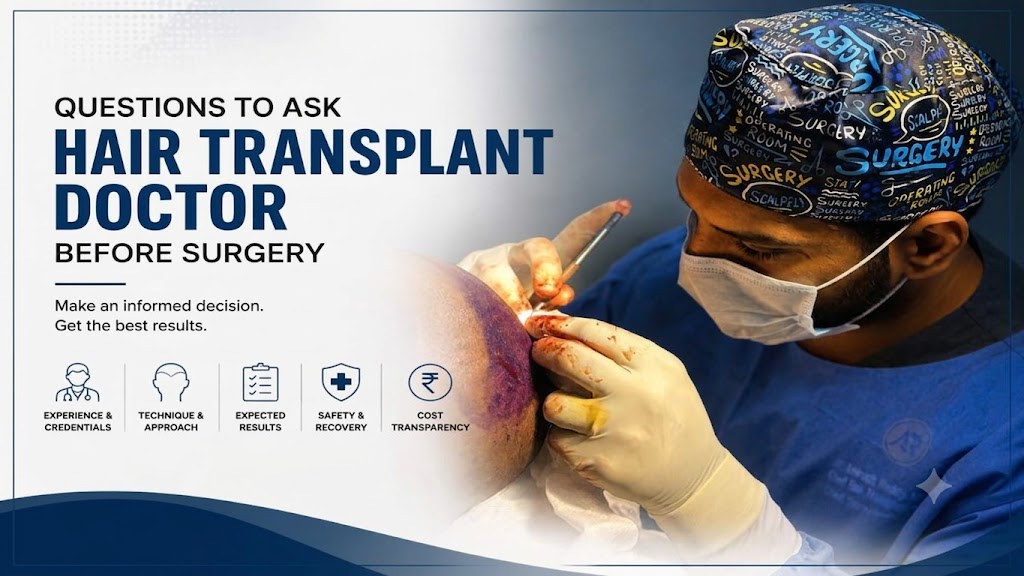
I have had patients come to me after procedures at other clinics. Patchy results. Hairlines that looked artificially placed rather than naturally grown. Donor areas that were harvested so aggressively there was nothing left to work with. In almost every case, the warning signs were present at their original consultation. They just did not know the right questions to ask their hair transplant doctor.
A hair transplant is permanent. Who performs it, how they plan it, and what they tell you beforehand matters more than most people realise when they first walk into a clinic. These are the questions worth asking before you commit to anything.
Will you personally perform the surgery or will technicians handle it?
This is the most important question on this list, and the one most patients never ask.
Hair transplant surgery in India has a growing problem: clinics that put a senior doctor in the consultation room and in their marketing, then hand the actual procedure to unlicensed assistants. The doctor appears briefly, then moves on to another patient. The person extracting and placing your grafts is not the person you met, is not medically qualified, and is not legally permitted to perform surgery under NMC guidelines.
The consequences show up in the results. Graft survival rates drop. Hairlines look unnatural. Donor areas get over-harvested in ways that are not easy to correct later.
At my clinic, I perform every extraction and every Hairline designing myself. You can ask me this directly at your consultation. Any surgeon who deflects the question, or offers a vague answer about a team approach, is worth following up with questions like: who specifically will perform hairline designing and extraction during my procedure, from start to finish?
What are your qualifications, and how many procedures have you personally performed?
Dermatology training alone does not make a hair transplant surgeon. The procedure requires specific fellowship training in hair restoration, hundreds of hours of practice, and an aesthetic judgment that only develops over time and across many cases.
Ask for the surgeon’s medical degree and specialisation, specific fellowship or training in hair transplantation, membership in recognised bodies like FUE Asia, ISHRS, or AHRS India, and the number of procedures they have personally completed. Not the clinic’s combined count. Theirs specifically.
A surgeon with 200 cases is at a meaningfully different level than one with 1,000. The technical precision, the hairline design instinct, and the ability to handle unexpected situations mid-procedure all improve substantially with experience. This is not a field where all surgeons are equal.
Am I actually a good candidate for a hair transplant right now?
This is a question many clinics would prefer you not ask, because the honest answer is sometimes no.
Hair transplant surgery works by moving grafts from a stable donor area to a thinning or bald recipient area. If your hair loss is still actively progressing, transplanting too early can leave you worse off. You end up with transplanted hair in some areas and continued natural loss in others, creating an uneven result that is expensive and complicated to address.
A thorough surgeon will assess whether your hair loss has stabilised or is still progressing, the density and quality of your donor area, your age and likely future loss pattern, and whether non-surgical treatments like GFC therapy or PRP make more sense at this stage.
I have told patients to come back in a year. That conversation is harder in the short term. It is the right one. If a clinic runs a brief assessment and immediately confirms you as a candidate, that is worth slowing down for.
How many grafts do I need, and how did you arrive at that number?
Graft count is one of the most quoted and least explained numbers in hair transplant consultations. Clinics advertise packages of 2,000 grafts or 3,000 grafts as though these are standard sizes that fit any patient. They are not.
The right number for you depends on the size of the area being covered, the density you want to achieve, the donor density available at the back and sides of your scalp, and whether you are likely to need further procedures down the line. A responsible surgeon assesses donor density using trichoscopy before quoting any figure. A number given without a proper scalp examination is a guess, and guesses in this context tend to be revised upward after you have already committed.
Also worth asking: what happens if the surgeon encounters fewer viable grafts than expected during the procedure? How is that communicated, and how is it managed on the day?
Which technique is right for me, FUE or DHI, and why?
Both FUE and DHI are minimally invasive. FUE extracts individual follicles and places them after creating recipient sites. DHI uses a specialised implanter pen that combines site creation and placement in one step. The right choice depends on the area being covered, the density required, and the characteristics of your donor hair.
A clinic that recommends a technique before examining your scalp is applying a default rather than making a clinical decision. Ask the surgeon to explain why they are recommending a specific approach for your case. If the answer is tailored to your scalp, hair type and goals that is a good sign. If it sounds like something from a brochure, ask again.
What does recovery actually look like, and what are the real restrictions?
Most clinics hand patients a printed aftercare sheet and leave it there. What often gets skipped is an honest conversation about what recovery involves day by day: what you will see, what will look alarming but is completely normal, and what actually warrants a call to the clinic.
The specific questions worth raising: how many days before you can return to a desk job, when exercise and swimming are back on the table, what shock loss looks like and when to expect it, when visible growth typically begins and what signs should prompt you to get in touch immediately.
I have written a full week-by-week breakdown of FUE recovery on this site. The hair transplant recovery guide covers every stage from day one through to month twelve. Reading it before your consultation will make the conversation more useful for both of you.
What is the total cost, and what does it actually include?
Hair transplant pricing in Hyderabad varies significantly depending on the clinic, the surgeon, and what is genuinely included. The headline per-graft number rarely tells the full story.
A clinic with unusually low pricing is worth questioning, not celebrating. The per-graft rate often reflects who is actually performing the surgery and what standards are being maintained in the procedure room. For a detailed breakdown of what different graft counts cost in Hyderabad, the hair transplant cost guide on this site covers it transparently.
Can I see results from patients with a similar hair loss pattern to mine?
Before and after photographs are the most direct evidence of a surgeon’s actual work. Ask specifically to see cases comparable to yours: similar Norwood stage, similar hair type, similar age group.
Look at whether the hairline design looks natural or placed, the density in the transplanted area, the condition of the donor area after the procedure, and whether they have 12-month results, not just 6-month photos. Results at 6 months are still developing. At 12 months, you are seeing what a patient will actually live with.
Be cautious of clinics that only show their standout cases, or results from patients with a very different starting point to yours.
What follow-up support is included after the procedure?
The surgery is 1-2 days. The recovery and results unfold over twelve months. What happens during that window matters considerably: how accessible the clinic is, how quickly concerns are addressed, and whether your follow-up appointments are with the surgeon or with someone more junior.
Ask how many follow-up appointments are included, whether you can message or call during recovery if something does not look right, who the specific point of contact is, and at what stage a touch-up procedure would be considered and what that would cost.
A surgeon who is genuinely invested in your result will have specific answers to all of these. Vague reassurances about the team being available are worth pressing on.
One final question to ask your hair transplant doctor
Did the surgeon take time to explain things clearly? Did they answer your questions without rushing you toward a decision? Did they give you an honest assessment, even if that assessment was not what you came in hoping to hear?
A surgeon who is doing this work properly is not trying to close a booking on the day of your consultation. They are trying to make sure you are the right candidate, that your expectations are realistic, and that you will be satisfied twelve months from now. If something about the consultation felt rushed, vague or pressured, pay attention to that.
If you want to understand your hair loss stage before you go in, the baldness calculator on this site is a useful place to start.
Ready to Ask These Questions in Person?
Book a 15-minute discovery call with Dr. Anirudh. No sales pitch, no pressure. Just an honest conversation about your hair loss, your options, and whether surgery is the right step for you right now.
Explore:
FUE and DHI Hair Transplant |
Hair Transplant Cost in Hyderabad |
Recovery Guide


0 Comments